Moving abroad? Your home can come too.
A new job, higher studies or a move to be closer to your children. Whatever the reason, leaving India is a big step. You should not have to leave behind the dining table you grew up around, your books or your favourite kitchen things just because shipping them feels confusing.
Lifter Shifter packs your household goods to export standard, prepares a detailed list for customs, books sea or air freight, and coordinates delivery at the other end. One move manager guides you through every step, in plain language.
- Sea and air freight
- Export-grade packing
- Paperwork guidance
How a move abroad is different from a move within India
When you move from Pune to Kolkata, your things travel in one truck and reach in a few days. When you move abroad, they pass through many hands: our packers, a truck to the port or airport, export customs in India, a ship or plane, import customs in your new country, and then a local delivery team. Each step has its own rules and its own waiting time.
That is why an international move needs more planning, stronger packing and better paperwork. A carton that is fine for a road trip may not survive weeks in a container that is lifted by cranes and stacked with others.

It also means the choices you make early matter more. What you decide to ship, how you ship it and when you book all affect your cost and how long you wait for your things. A family that ships only what they truly need often pays less and settles in faster than one that ships everything "just in case".
Our job is to make these choices simple. We visit your home or do a video survey, look at what you plan to take, and explain your options honestly. If shipping your old sofa will cost more than buying a new one abroad, we will tell you. If your grandmother's brass utensils are worth the effort, we will pack them like the treasures they are.
Book a free home or video surveySea freight or air freight: choosing the right way
There are two main ways to send household goods abroad. Sea freight is slower but costs much less for large volumes. Air freight is fast but priced by weight and size, so it suits smaller loads. Many families use both: a few cartons by air to get started, and the rest by sea.
Sea freight
Best for a full home or a large part of it: furniture, appliances, kitchen sets, books and boxes of clothes. Your goods travel in a steel container. You can book a whole container for yourself, or share one with other customers. It takes longer, but the cost per box is much lower than air.
Air freight
Best for things you need soon after landing: work clothes, children's school things, some kitchen basics, important books. Goods are packed in strong cartons and travel as cargo on a flight. It is much quicker, but you pay by weight or size, so heavy furniture rarely makes sense by air.
Full container or shared container?
If you choose sea freight, the next question is whether you need a container of your own. Here is a simple comparison. Your move manager will suggest the right option after the survey, based on how much you are sending.
| Full container | Shared container | |
|---|---|---|
| What it means | The whole container carries only your goods. It is loaded at or near your home and sealed. | Your goods share space with other customers' goods. You pay only for the space you use. |
| Best for | A full 2 or 3 BHK home with furniture and large appliances. | A smaller load: a studio, some furniture, or mostly cartons. |
| Cost | Higher in total, but good value when you fill it. From ₹2,50,000. | Lower in total for small volumes. From ₹60,000. |
| Timing | Leaves as soon as it is booked on a ship. Usually quicker. | Waits until the container is filled with other loads, so it can take longer. |
| Handling | Less handling, as your goods stay in one sealed container until arrival. | A little more handling at the warehouse, so wooden crating and good packing matter more. |
Packed for weeks at sea, not a few hours on the road
A container can face heat, humidity and constant movement for a long time. Boxes at the bottom carry the weight of everything above. So export packing is stronger at every layer: thicker cartons, more cushioning, moisture protection and wooden crates for anything that can break.
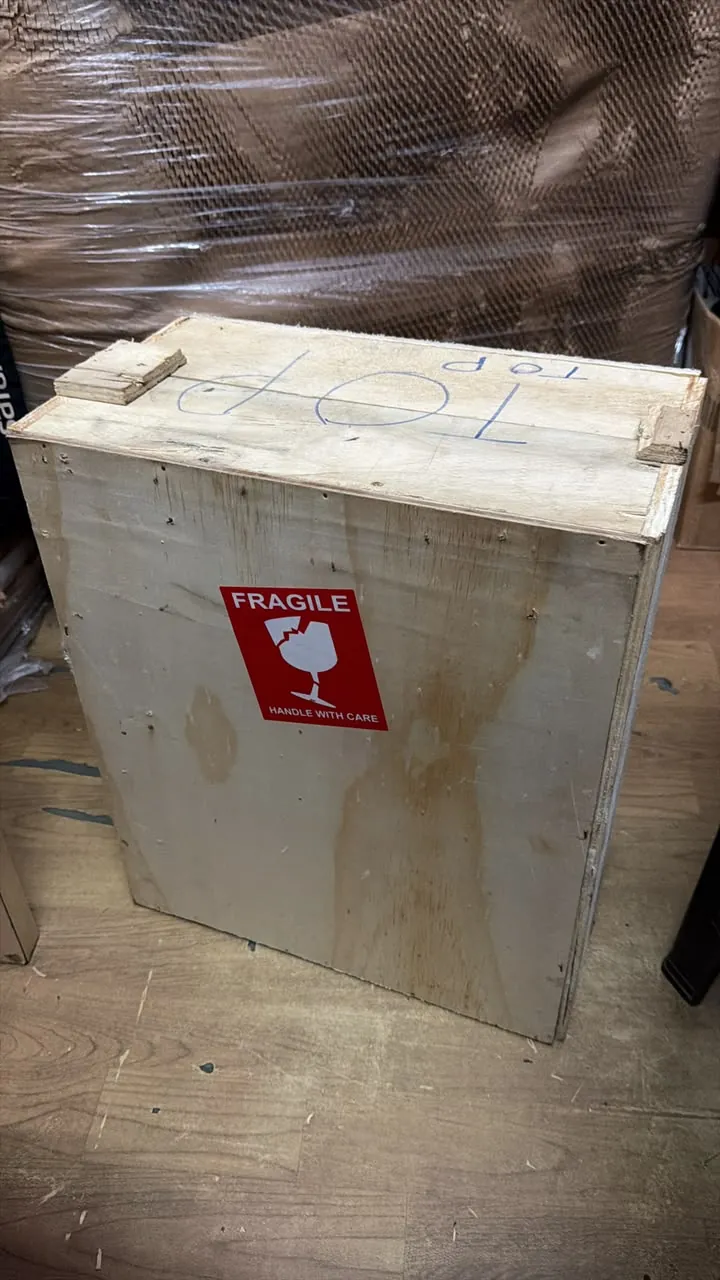
Our packers fill every carton fully so it does not crush, seal it well, and write a number on it that matches your inventory. Nothing is left loose. Furniture legs are removed where possible, and screws go into labelled bags taped to the item, so putting things back together in your new home is easy.
Wooden crating
Glass table tops, mirrors, marble items, idols and large paintings go into a wooden crate built to their size. Many countries ask that wooden packing is treated against pests, so we use treated wood where it is needed.
Protection from moisture
Sofas, mattresses and wooden furniture are wrapped in plastic and stretch film. Clothes and linen go in sealed cartons. This matters most if your move falls in the monsoon months.
Electronics and appliances
TVs, music systems and computers go in their original boxes if you have them, or in foam and double-wall cartons. Washing machines are secured so the drum does not move. Check voltage and plug type abroad before deciding to ship them.
Puja items and keepsakes
Brass and silver idols, a small wooden mandir, framed family photos. These are packed by hand with extra layers and marked so they are opened first at the other end.
A clear list of every box, for you and for customs
Customs officers in both countries want to know what is in your shipment. A vague list like "household items, 40 boxes" can lead to questions, inspections and delays. So we make a detailed inventory while we pack, and you check and sign it before anything leaves your home.
Every carton numbered
Each box gets a number. The same number appears on the list, with a short, honest description like "Box 12: kitchen, steel utensils, pressure cooker". Large items like a sofa or a fridge get their own line.
Condition noted
We write down the condition of furniture and appliances, such as "small scratch on left door". This protects you if you need to raise a claim later, and it avoids arguments at delivery.
Values where needed
Some countries and insurance plans ask for an approximate value of your goods. We help you list sensible values for items like electronics and furniture. Your move manager will tell you if this is needed for your move.
A copy for you
You get a copy of the signed inventory. Keep it handy. When your shipment arrives, you can tick off each box number as it comes through the door and know straight away that nothing is missing.
Paperwork, without the panic
Customs rules differ by country, and they can change. We guide you on what is needed for your destination, so you are not left guessing. In general, most moves need a copy of your passport, your visa or residence permit for the new country, the signed inventory, and an address in India and abroad where you can be reached.
Some countries ask for more, such as a letter from your employer, proof of how long you lived in India, or a form declaring that the goods are your own used belongings. Your move manager will give you a written list for your move and check your papers before the shipment is booked, so nothing holds it up at the port.
One honest note: customs decisions are made by the authorities, not by us. We prepare everything carefully to make clearance smooth, but duties, taxes and inspections are set by the country you are moving to.
What should stay behind
Some things cannot go in a household shipment, either for safety or because most countries do not allow them. The exact list depends on your destination, but these are usually not allowed:
- Flammable things: gas cylinders, kerosene, petrol, paint, thinner, aerosol sprays, matchboxes, firecrackers.
- Perishable food: fresh fruit, vegetables, homemade pickles, sweets, dairy and anything that can rot.
- Plants, seeds and soil: including your tulsi plant and garden pots with soil.
- Valuables: cash, jewellery, gold coins and important original papers. Carry these with you.
- Restricted items: weapons, some medicines, animal products and anything your destination bans. Ask us about anything you are unsure of.
How long will it take for my things to arrive?
This is the question everyone asks, and the honest answer is: it depends on the route, the shipping method, the season and customs at the other end. We will give you a realistic estimate for your move, not an optimistic one. Here are the stages and the time each one usually takes.
-
1
Survey and quote · 2 to 4 days
We see what you plan to ship, suggest sea, air or both, and send a written quote with what is and is not included.
-
2
Documents and booking · 1 to 2 weeks
You share your papers, we check them, and we book space on a ship or flight.
-
3
Packing day · 1 to 2 days
Export packing, crating and the inventory, usually done at your home.
-
4
Export customs in India · 3 to 5 days
Your shipment reaches the port or airport and goes through export clearance before it is loaded.
-
5
In transit · sea 20 to 45 days, air 5 to 10 days
The longest stage for sea freight. Your move manager shares updates when the ship sails and when it reaches.
-
6
Import customs and delivery · 1 to 3 weeks
Clearance in your new country, then delivery to your new home. You may need to be present for customs.
Plan to live without your sea shipment for a while after you land. Most families carry a suitcase of essentials, send a small air shipment, and let the rest follow by sea.
Delivery at your destination, coordinated for you
Your move does not end at the port in India. Once your shipment reaches your new country, it still needs customs clearance, transport to your new home and unloading. We work with destination agents who handle this locally, and we stay your point of contact the whole way, so you are not left dealing with strangers in a new city.
Before your goods arrive, your move manager shares the details of who will contact you, what they will need from you, and roughly when delivery can happen. If your new flat is not ready yet, we can discuss short-term storage at the destination, where available, at an extra cost.
On delivery day, check the box numbers against your inventory. If something is damaged, take photos and tell us the same day. Note that services like unpacking and furniture assembly at the destination depend on what you choose in your quote, so we list them clearly up front.
Learn about transit insuranceSmaller options for smaller loads
A student going abroad for a master's degree does not need a container. Neither does someone sending a few cartons to a son or daughter already settled overseas. For smaller loads, we offer simpler options.
Excess baggage
When your airline allowance is not enough, send extra cartons of clothes, books, kitchen things and personal items as unaccompanied baggage. It usually costs less than paying the airline for overweight bags. We pack the cartons, list them and arrange collection at your destination or delivery to your address, depending on the route.
Parcels and documents
A box of winter clothes for your child, a set of books, or important papers that need to reach someone abroad. We help you pack it properly, fill in the required forms and send it by a suitable courier service. Food items and restricted goods follow the same rules as larger shipments.
What to do, and when, before you move abroad
Moving abroad has many moving parts, and not all of them are about boxes. Use this list to stay ahead. Start early: the families who feel calm on moving day are usually the ones who began planning a couple of months before.
Tip: make a "do not pack" corner in one room. Put your passports, tickets, medicines, laptop and jewellery there before the packers arrive, so nothing important ends up sealed in a carton by mistake.
Read our full moving guideQuestions about moving abroad
Moving to another country raises a lot of questions. These are the ones we hear most. For anything specific to your destination, talk to your move manager.
Read all questionsDo you move goods to my country?
Tell us where you are going and we will confirm whether we can arrange the move and delivery there, before you book anything.
How is the cost worked out?
Mainly by the volume or weight of your goods, sea or air, full or shared container, and the services you choose at both ends. Your written quote lists each part.
Are customs duties included in the quote?
Duties and taxes are set by the destination country and are usually paid separately. We will tell you clearly what our quote covers and what it does not.
Can I pack some boxes myself?
For international moves, it is safer to let us pack. Customs may question boxes packed by the owner, and insurance often covers only professionally packed goods.
Can I ship my car or bike abroad?
It is sometimes possible, but many countries have strict rules for vehicles. Ask us early and we will tell you whether it is practical for your destination.
Is insurance available?
Yes, transit insurance is available at an extra cost. We explain what it covers in simple words so you can decide.
How far ahead should I book?
As early as you can, ideally a few weeks before your flight. This leaves time for documents, booking space and packing without a rush.
Planning a move abroad? Let's start with a survey.
Tell us where you are going and what you want to take. We will explain your options and send a clear written quote. No pressure, no obligation.