Your car arrives at your new home ready to drive.
Moving to a new city is tiring enough without a two-day drive at the end of it. Let us carry your car instead. We pick it up from your door, record its condition with photos, load it onto a car carrier and deliver it to your new address.
You choose an open carrier or a fully covered one, depending on your car and your budget. Your move manager keeps you updated on the way, and at delivery we check the car with you against the same report before you take the keys.
- Open or covered carrier
- Photo condition report
- Transit insurance available
Open carrier or enclosed carrier?
An open carrier is the long, two-level truck you often see on highways with cars on top and below. It is the most common way to move a car in India, and it is the more affordable option. Your car is tied down firmly but stays open to dust, sun and rain on the way.
An enclosed carrier is a covered container. Your car travels fully protected from weather, road dust and flying stones. It costs more, but for a new, luxury or vintage car, many owners feel it is worth it. Not sure? Tell us about your car and your route, and we will help you choose honestly.
| Open carrier | Enclosed carrier | |
|---|---|---|
| Protection | Car is strapped firmly, but open to dust, sun and rain. Fine for most everyday cars. | Fully covered from weather, dust and stones. The car arrives as clean as it left. |
| Cost | Lower, because several cars share one carrier. From ₹9,000. | Higher, because of the extra protection and fewer cars per trip. From ₹14,000. |
| Availability | Runs often on most major routes, so dates are usually easier to get. | Fewer trips, so it is best to book a little earlier. |
| Best for | Hatchbacks, sedans and SUVs in daily use, and budget-conscious moves. | Luxury, brand-new, vintage and specially painted cars, or long monsoon routes. |
We collect from your door, and write down everything
You do not have to drive to a depot on the highway. Our driver comes to your home at the agreed time. In most cases the car is driven a short distance to where the carrier is parked, because big carriers often cannot enter society gates or narrow residential lanes. If the carrier can come close, it will.
Before the car moves even one metre, we walk around it with you and fill a condition report. Every existing scratch, dent, chip and crack is marked on a simple diagram of the car. We take photos from the front, back, both sides, the roof and close up on any marks, and we note the odometer reading and fuel level.
You read the report, agree with it and sign it. Our team signs too, and you keep a copy. We also suggest you shoot a slow video around the car on your own phone. It takes two minutes and gives you a complete record with the date and time on it.
This report is the most important paper in the whole process. At delivery, we compare the car with it line by line. Because both of us signed it at the start, there is no confusion and no argument about what was there before and what is new.
If you cannot be there in person, a family member, friend or office driver can hand over the car. Just tell your move manager their name and number in advance.
Preparing your car for the journey
A little preparation on your side keeps the car safe and the handover quick. Do these things a day or two before pickup, not on the morning itself.
Clean it inside and out
A washed car makes the condition check honest. Dust and mud can hide small scratches, which then look "new" at delivery. Clean the inside too, so nothing is left rolling under the seats.
Remove valuables and loose things
Take out sunglasses, chargers, the music system faceplate if it comes off, umbrellas, idols on the dashboard, gym bags and anything in the boot. A car carrier is not meant for luggage, and loose items can move and damage the interior.
Keep fuel low
About a quarter tank or less is plenty. It is enough to drive the car on and off the carrier and to a petrol pump at the other end, and it keeps the car lighter and safer during the trip.
Take care of the FASTag and toll tags
The car will pass through toll plazas while on the carrier. Some owners prefer to keep a small balance or remove the tag to avoid any confusion. Ask your move manager what is best for your route.
Hand over one key, keep the spare
Give our team one working key and keep the spare key safely with you. If the car has a special immobiliser, a hidden switch or an alarm, show the driver how it works.
Check the basics and keep papers ready
Check tyre pressure and battery, and tell us about any leaks or faults. Keep copies of the RC, valid insurance and your ID ready. Your move manager will confirm exactly which papers your move needs. Keep the originals with you.
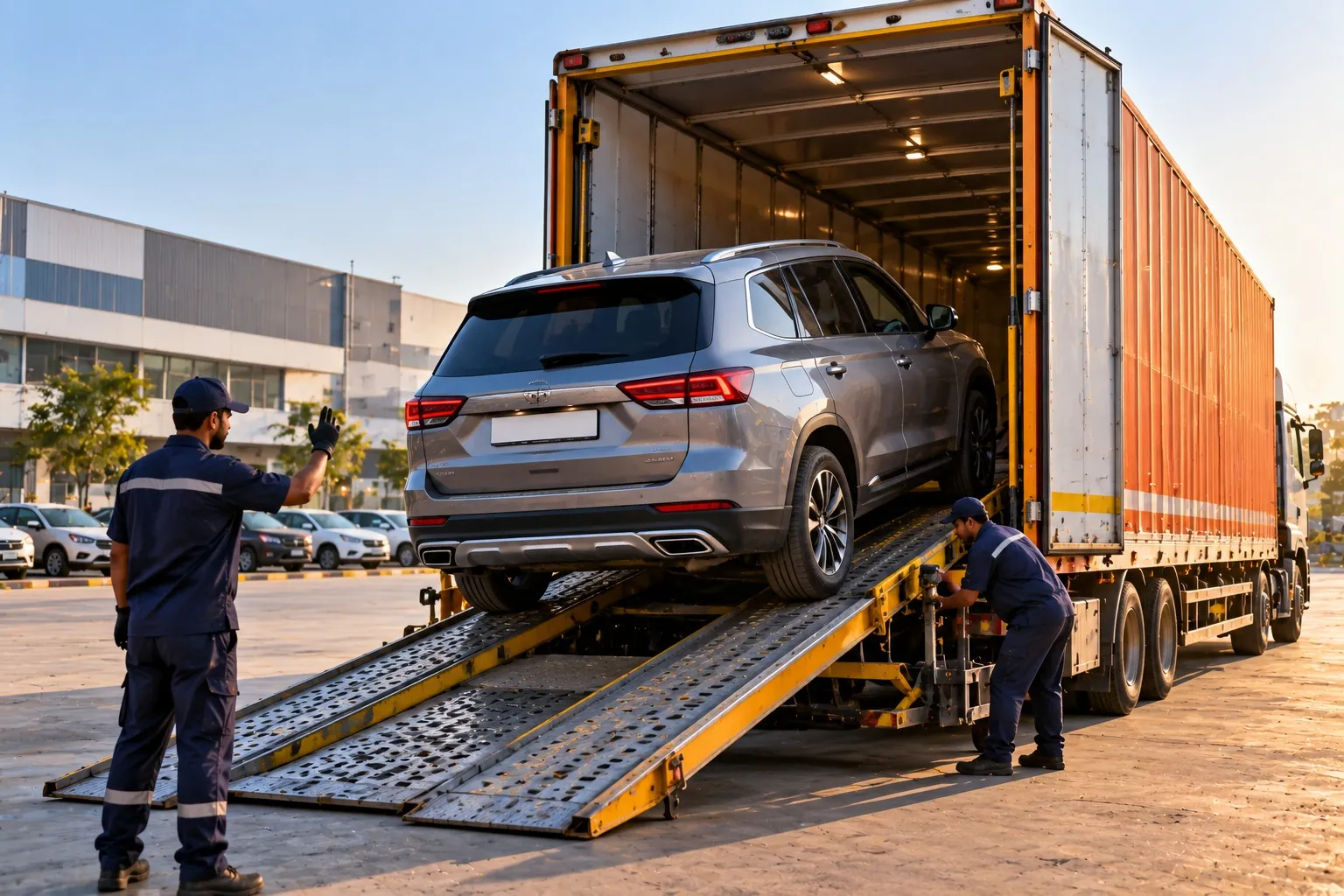
Locked in place for every pothole and turn
Most damage in car transport happens in the few minutes of loading and unloading, or when a car is not tied down properly. So this is where we slow down the most.
-
1
Driven up proper ramps
A trained driver takes the car slowly up strong loading ramps, with a second person guiding from outside. Low cars get extra care so the front bumper does not touch the ramp.
-
2
Wheel straps on all four tyres
The car is tied through the wheels with strong straps, not by its body. The tyres hold the car down, so no strap presses against the paint or the bumpers.
-
3
Wheel blocks and handbrake
The car is left in gear or in park with the handbrake on, and blocks are placed at the wheels. Even on a steep ghat road, it cannot roll forward or back.
-
4
A final check before leaving
Windows closed, mirrors folded, antenna down, doors locked and straps tested. The straps are checked again at planned stops on the way.
On an open carrier, your car may sit on the upper or lower deck. Both are safe when the car is strapped properly. The upper deck stays away from road splash and mud, while the lower deck is shielded from the sun from above. If you have a preference, mention it when you book and we will try our best to arrange it.
Moving your home with us at the same time? We plan the car carrier and the household truck on matching dates, so your car does not reach a week before your sofa, or the other way round. You also get one move manager and one bill for both, which makes life much simpler during a busy month-end shift.
You always know where your car is
Handing over your car keys and watching it drive away is not easy. So we do not go quiet once it leaves. Your move manager shares updates at each stage: when the car is loaded, when the carrier leaves, while it is on the road, and when it is near your city.
You can call or message your move manager any time to ask where the car is. If there is a delay because of heavy rain, a festival rush or a road closure, we tell you early and give you a new expected time, so you can plan your day around it.
- Condition report signed
- Loaded and strapped
- On the highway
- Near your city, call before arrival
- Checked together and handed over
How long does car transport take?
It depends mostly on the distance, the route and how often carriers run on it. These are general bands. Your move manager will give you an expected delivery date in writing when you book.
| Distance | Example route | Usual transit time |
|---|---|---|
| Within the same city | Noida to Gurugram | Same day or next day |
| Up to about 500 km | Mumbai to Pune or Goa | 2 to 3 days |
| About 500 to 1,500 km | Delhi to Ahmedabad | 4 to 6 days |
| More than 1,500 km | Delhi to Bengaluru | 6 to 9 days |
| North-east and hill areas | Kolkata to Guwahati | 8 to 12 days |
Check it together before you take the keys
We call you before the carrier reaches your city and agree on a time and place. The car is unloaded slowly down the ramps and, where possible, driven right to your building. Try to have the delivery in daylight. Small marks are much easier to see in sunlight than under a street lamp at night.
Take out your copy of the condition report and your own photos. Walk around the car with our driver. Then sit inside, start the engine and check that the lights, AC and music system work.
Look at the body
Bumpers, doors, roof, bonnet and the lower edges under the doors. Compare every mark with the pickup report.
Check glass, lights and mirrors
Look for chips on the windscreen and cracks on the headlights, tail lights and mirrors.
Match the odometer
The reading should be close to the one at pickup, with only a few kilometres added for loading and unloading.
Write it down before signing
If anything is new, note it on the delivery report with a photo before you sign. Then tell your move manager within 48 hours.
Luxury, new and vintage cars
Some cars need more than the usual care. Tell us about yours when you ask for a quote, and we will plan the carrier, the loading and the timing around it.
Luxury and low cars
We suggest an enclosed carrier. Low sedans and sports cars may need longer ramps or extra boards so the bumper and underbody stay clear while loading. Only experienced drivers handle these cars.
Brand-new cars
Just bought a car in one city and need it in another? Keep the protective film on if it has one. Temporary registration rules and papers can differ, so your move manager will confirm what is needed before pickup.
Vintage and classic cars
An old Fiat or Ambassador may have soft tyres, fragile chrome and brakes that need a gentle hand. We go slowly, use extra soft padding at the tie points and plan an enclosed carrier wherever possible.
Insurance for high-value cars
For any car, and especially an expensive one, transit insurance is worth thinking about. Your move manager will explain what it covers in plain words. About insurance.
Should you drive it yourself or ship it?
We are a car transport company, but we will not pretend shipping is always the right answer. For a short trip, driving may be simpler. For a long one, it often is not. Here are the real pros and cons, so you can decide for yourself.
Driving it yourself
Good: you can carry some luggage in the car, the car arrives the same day you do, and for a trip of a few hours it can cost less than shipping.
Not so good: on a long route you pay for fuel, tolls, food and maybe a hotel night. The car adds hundreds or thousands of kilometres and wear on tyres and brakes. And you arrive tired, just when you need energy to unpack and settle in. Driving alone at night on highways also carries real risk.
Shipping it with us
Good: no extra kilometres on the car, no long drive, and you can fly or take the train with your family. The condition is recorded at both ends, and transit insurance is available.
Not so good: you are without your car for a few days, so plan local travel for that time. You cannot use the car to carry luggage. And on an open carrier, it will arrive dusty and may need a wash.
A simple rule many people use: if you can drive it comfortably in a day, driving can make sense. If it means two or more days on the road, shipping is usually safer and less tiring. Moving your home too? Add the car to your intercity move and plan both together.
Car transport questions
These are the questions car owners ask us most often. If yours is not here, call us or send a WhatsApp message on +91 93261 78863.
Read all questionsCan I keep my luggage inside the car?
Please do not. Loose items can shift and damage the interior, and they are not covered as part of the car. Send them with your household goods instead.
How much fuel should I leave?
About a quarter tank or less. That is enough for loading, unloading and reaching a petrol pump.
Which papers do I need?
Usually copies of the RC, valid insurance and your ID. Your move manager will confirm the exact list for your car and route. Keep the originals with you.
Open or enclosed: which should I pick?
For most everyday cars, an open carrier works well. For luxury, new or vintage cars, an enclosed carrier gives full protection. We will help you decide.
Can someone else hand over or receive the car?
Yes. Share their name and number with your move manager in advance, and they can do the check and sign for you.
Can you move a car that does not run?
Often yes, with extra equipment to load it. Tell us when you book so we can plan for it.
Can you move my car and bike together?
Yes. Many families move both along with their home. See bike transport.
Skip the long drive. Send your car with us.
Tell us your car model and both cities. We will call you back with a clear, written price for open or enclosed transport.